Home / Paint Colours by Room / Paint Colours That Make a Room Look Bigger
Paint Colours by Room
Paint Colours That Make a Room Look Bigger
Short Answer
Use a single pale, warm colour on the walls and ceiling, with skirting and door frames in a matching soft white. That blurs the edges of the room so it reads as one open space. Add a mirror opposite the window and keep large furniture in a similar tone to the walls.
At a Glance
- Most effective move: one pale colour on walls and ceiling, woodwork to match
- Shade to pick: pale and warm, which reflects light without looking stark
- Clever use of dark: one deep wall can add depth if the rest stays pale
- What does not help: a white ceiling line that chops a low room in half
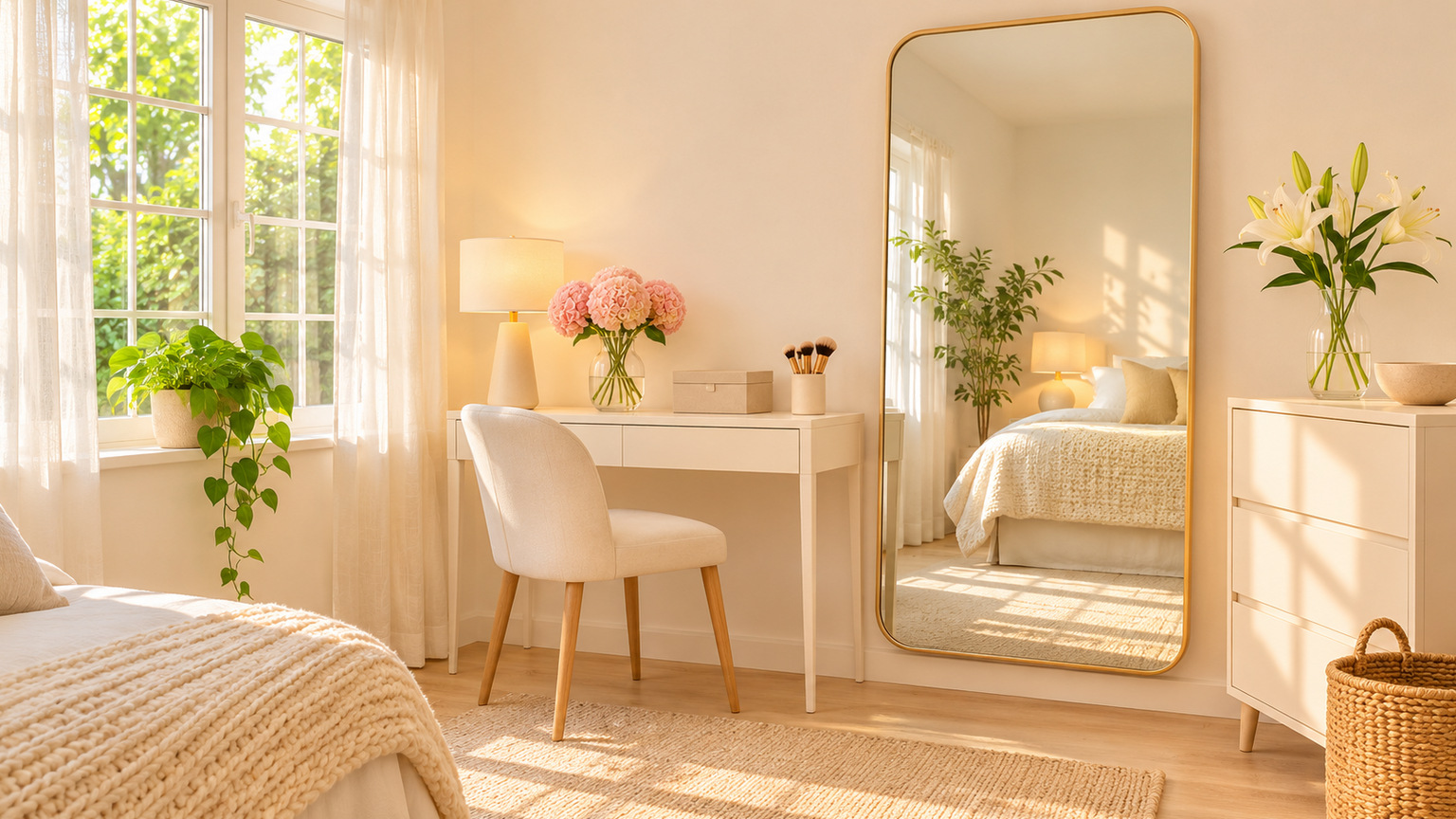
Paint can make a room look bigger, but no colour works magic on its own. Pale warm shades, one colour carried across walls and ceiling, and woodwork that matches the walls all help, because they remove the lines your eye uses to measure a room. Dark colours can work too, in the right place.
How your eye measures a room
Your eye judges the size of a room by the lines in it: where the wall meets the ceiling, where the skirting meets the floor, where one colour stops and another starts. Every line is a measurement, and a room full of lines feels smaller than the same room with none. Paint works on a room by removing those lines, not by any optical illusion.
That is why one continuous colour feels larger than a room painted in three contrasting shades. The walls, the ceiling and the woodwork read as a single surface, and your eye has nothing to measure against. The effect is modest but real, and it costs nothing more than choosing the paint carefully.
Pale and warm beats brilliant white
Brilliant white is the colour people reach for first when they want a room to look bigger, and it often disappoints in a room with poor light. It can look cold and flat, and it shows every bump and mark on the wall. A pale warm shade reflects nearly as much light, but it gives the room a sense of warmth that makes the space feel welcoming rather than bare.
Good choices are warm white, pale greige, soft mushroom and light plaster shades. They all bounce light around the room, and they look good with wooden floors and pale furniture. Test them in the dimmest corner of the room, because that is where a shade that is too cold will look grey and a shade that is too warm will look yellow.
Carrying colour onto the ceiling
Painting the ceiling the same pale colour as the walls is the single most effective trick for a low room. The line where wall meets ceiling disappears, and the room feels taller. This works best with very pale shades, and it is worth doing even if it feels unusual at first, because the result is visible the moment you walk in.
Woodwork follows the same logic. Skirting boards and door frames in a soft white that matches the wall colour blur the outline of the room, while brilliant white woodwork draws a hard line around it. If you are repainting a small room, matching the woodwork white to the wall tone is a small change that makes a visible difference.
Your eye measures a room by its lines, so a room with fewer visible edges feels larger than the same room full of contrast.
Using dark colours to add depth
Dark paint does not always make a room feel smaller. A single dark wall at the far end of a long room pulls that wall towards you and makes the room feel less like a tunnel. A dark alcove or a dark wall behind shelves reads as depth rather than as a boundary, because your eye treats it as a recess.
The mistake is painting every wall dark in a small room with one small window. That will close the room in, however good the colour is. Use the dark shade on one wall, keep the ceiling white or pale, and let the other walls stay light enough to bounce daylight around. If you are unsure, paint the dark wall first and live with it for a week.
What about stripes and feature walls
Stripes and bold feature walls are often suggested for small rooms, but they usually make the problem worse. A striped wall gives your eye a pattern to measure, and a bold feature wall becomes the thing the room is measured against. Both draw attention to the size of the room rather than away from it.
A feature wall can still work if it is in a slightly deeper version of the same colour as the other walls, because the difference is gentle and the room still reads as one space. A strong contrast, on the other hand, chops the room up. If you want a feature, use a picture, a mirror or a piece of furniture instead of a wall of paint.
Light, mirrors and furniture
Paint is only part of the answer. A large mirror opposite the window doubles the light and the view, pale flooring makes the room feel wider, and furniture in a similar tone to the walls blends in instead of breaking the space up. Curtains hung close to the ceiling and in a colour close to the walls make the window feel taller.
Checklist before you paint: pick a pale warm shade, carry it onto the ceiling, match the woodwork white to the wall tone, and test it in the darkest corner. Paint a large tester and live with it for a few days. If the room feels open and calm in the morning and the evening, you have the right colour, and the mirror and curtains will do the rest. The same pale warm approach suits a living room that feels cramped.
More guides on this topic