Home / Paint Colours by Room / Best Paint Colours for a Bathroom
Paint Colours by Room
Best Paint Colours for a Bathroom
Short Answer
Choose a pale, fresh shade and a paint made for bathrooms, because ordinary emulsion can peel in steam. Test the colour against your tiles and suite, and keep the ceiling the same pale shade so a small bathroom feels taller. Fix ventilation before you paint, not after.
At a Glance
- Freshest choices: pale blue, soft white and light sage green
- Finish to use: a bathroom paint made for damp rooms
- Small bathrooms: one pale colour on walls and ceiling feels larger
- Check first: whether the extractor fan works before you paint
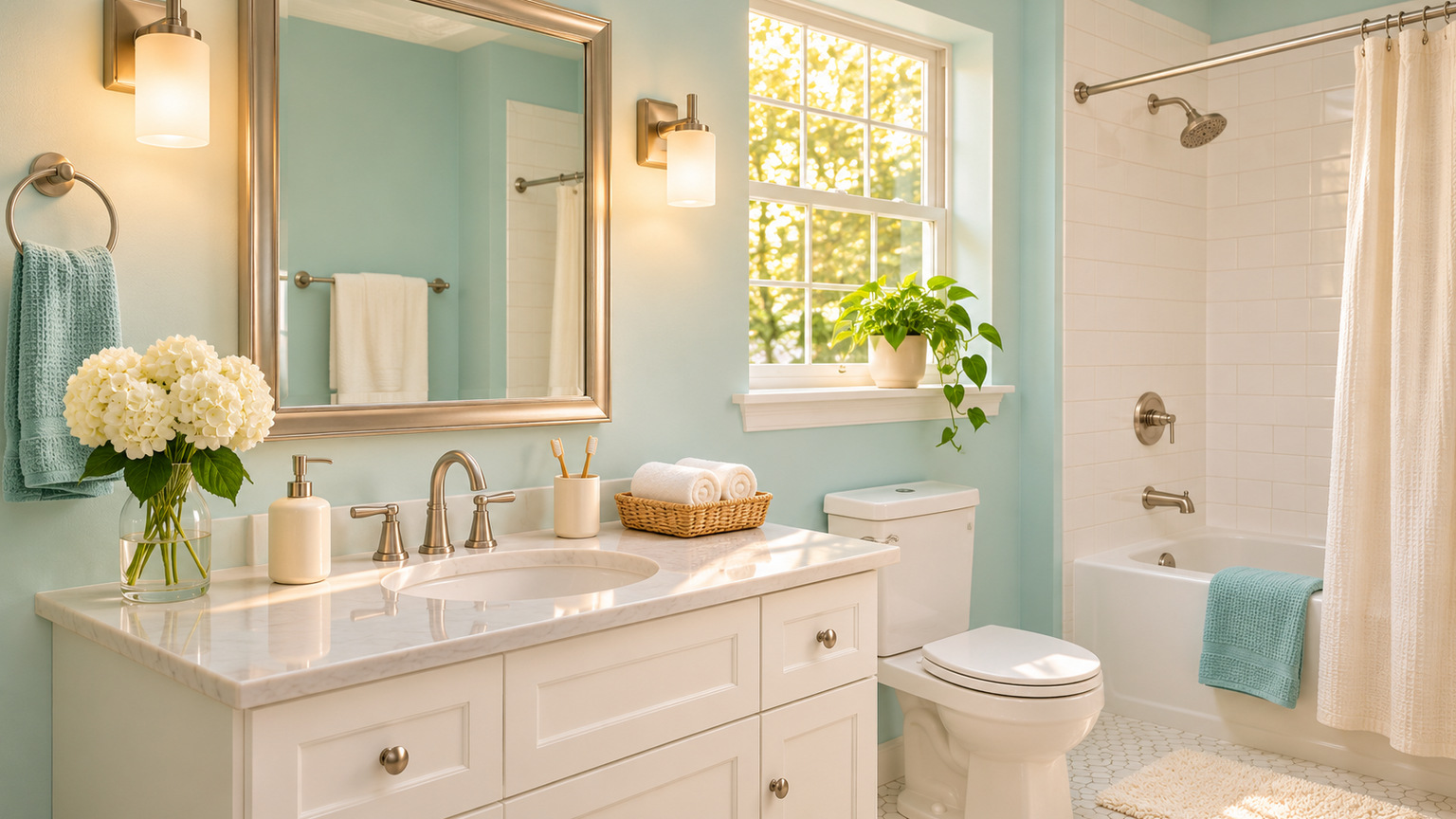
A bathroom colour has to cope with steam, small windows and hard surfaces, so pale shades usually win. Soft white, pale blue and light sage feel fresh and clean, while a deep tone on one wall can give a small bathroom a spa like feel. The finish matters here more than in any other room.
Steam is the first problem to solve
Bathrooms are the dampest rooms in the house, and paint fails there faster than anywhere else. Steam from a hot shower gets into ordinary emulsion, softens it and lifts it from the wall, usually above the bath or shower first. A bathroom specific paint is made to resist that moisture, and it is worth the extra cost because repainting a steamy bathroom is a job nobody wants to repeat.
Before you paint, check that the extractor fan works and that the window opens properly. No paint will last in a bathroom with no ventilation, and a fan that runs for a while after a shower makes more difference than any paint choice. If there is mould on the walls, treat it and let the wall dry fully before you start.
Pale colours suit most bathrooms
Most bathrooms are small and have one small window, so pale colours do the most work. A soft white, a pale blue or a light sage makes the room feel brighter and cleaner, and it shows off white tiles and a white suite rather than competing with them. Pale colours also make it easier to see when the room needs a clean.
A brilliant white can look cold in a bathroom with no natural light, so a white with a warm or blue undertone usually looks better. Hold the sample against your tiles, because a white wall next to cream tiles can look grey, and a blue wall next to a blue suite can look washed out. The pairing matters more than the shade on its own.
Deep colours for a spa feel
A deep colour can make a bathroom feel like a spa, and it works best on one wall or in a larger bathroom with good light. Dark green, deep navy and charcoal all suit bathrooms, especially with brass fittings and wooden accessories. The contrast with a white suite makes the room feel deliberate rather than dark.
In a small bathroom, a deep colour on every wall can feel oppressive, so use it on the wall behind the bath or the basin and keep the rest pale. Paint the ceiling the pale shade, not the dark one, so the room keeps its height. If you are unsure, paint the deep colour on one wall first and live with it for a week.
No paint lasts in a bathroom with no ventilation, so fix the fan before you open the tin.
Working with tiles and suites
The wall colour has to live with your tiles and your suite, and those are hard to change. A coloured suite in avocado or pink limits your choices, so pick a neutral wall that tones with it rather than fighting it. A white suite gives you freedom, and most wall colours will work, so choose by the light and the size of the room instead.
Tiles set the tone too. Patterned floor tiles need a quiet wall colour, while plain white tiles leave room for a stronger wall shade. If your tiles have a warm tone, a warm wall colour will sit better, and if they are cool grey, a cool wall colour will match. Test your sample on the wall above the tiles, where the two meet.
Small bathrooms and windowless bathrooms
A small bathroom feels larger when the walls and ceiling are one pale colour, because there is no line to break the space up. A soft sheen finish reflects a little light and helps a windowless bathroom feel less flat. Keep accessories pale too, and let one darker item, like a wooden stool or a dark mirror frame, give the room its contrast. The guide to colours for a bigger room has more ways to open a small space up.
Windowless bathrooms need a colour that looks good under electric light, so test your sample with the bathroom light on and the door closed. A pale blue can look grey under a cool bulb, and a warm white can look yellow under a warm one. The same light check matters in a living room, where the lamps change the colour just as much. If the light is harsh, a soft mid tone shade will look better than a very pale one.
Painting and keeping it fresh
Clean the walls with a sugar soap solution before you paint, because soap and shampoo leave a film that stops paint sticking. Fill any cracks, sand them smooth and use a primer on bare patches. Two coats of bathroom paint, with proper drying time between them, will last far longer than one thick coat rushed in an evening.
Keep a little paint aside for touch ups around the bath and the window, where steam does the most damage. Wipe the walls down now and then to stop mould taking hold, and run the fan after every shower. If paint does start to peel, it usually means moisture is getting in somewhere, so find the cause before you repaint the patch.
More guides on this topic