Home / Farrow and Ball Colours / Farrow and Ball Grey Colours: A Complete Guide
Farrow and Ball Colours
Farrow and Ball Grey Colours: A Complete Guide
Short Answer
Look at the undertone first and the depth second. Warm greys suit dim rooms and wooden floors, cool greys suit bright rooms and modern furniture. Test three greys on the wall opposite the window at midday, when the undertone is easiest to see.
At a Glance
- Main decision: the undertone, warm or cool, not the depth of grey
- Pale and safe: Ammonite and Cornforth White for most rooms
- Mid and settled: Elephant's Breath and Moles Breath for larger spaces
- Deep and bold: Down Pipe and Railings for feature walls and doors
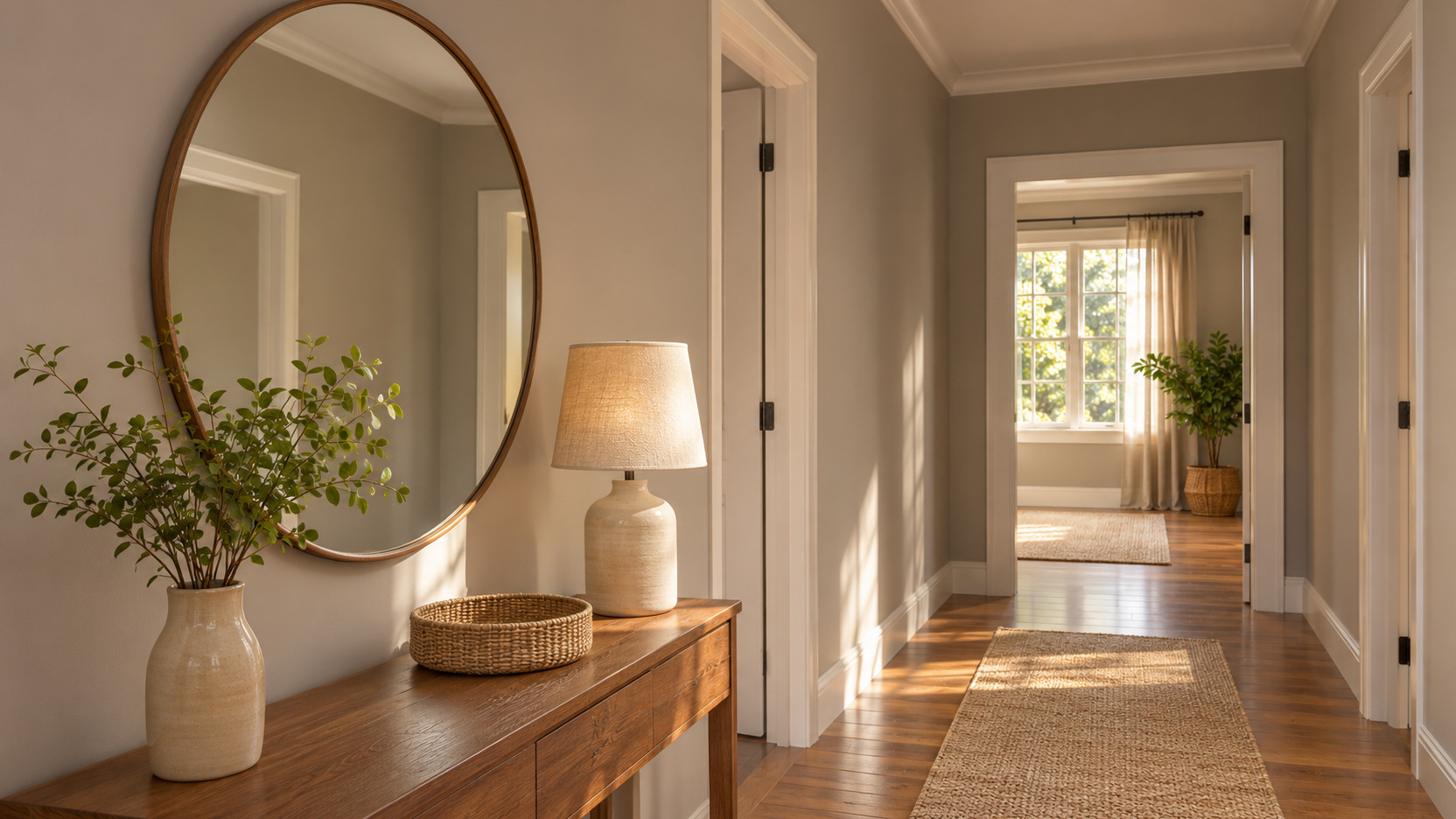
Grey is the colour most people repaint. Not because grey is a bad choice, but because the grey they chose looked different on the wall from the card, and the difference was the undertone. Farrow and Ball greys are soft and chalky, and each one leans warm or cool in a way that only shows in your own light.
The repaint problem
Ask a decorator which colour they repaint most often and the answer is usually grey. The story is always the same: the shade looked elegant on the card, it looked fine in the shop, and then it went on the wall and turned blue, or lilac, or cold. The paint was not faulty. The undertone was simply stronger in that room's light than it was on the card.
Farrow and Ball greys are especially prone to this, because their muted, chalky tone lets the undertone show through. That is also what makes them beautiful when they work. The way to avoid a repaint is to test the grey the way the room will actually show it: on a large patch, at midday, against your floor and your sofa.
Reading the undertone
Hold the sample against a plain white sheet of paper in daylight. A cool grey will look blue or faintly violet beside the white, a warm grey will look beige or faintly pink, and a grey with no visible lean is close to neutral. That lean is the whole decision, and it is worth five minutes of your time before you spend a weekend painting.
Then check the lean against the biggest surfaces in the room. A cool grey suits a grey carpet, a pale floor and chrome fittings. A warm grey pairs well with a timber floor, a beige carpet and brass fittings. If the sample makes the floor look orange, or the sofa look dirty, the temperature is wrong for that room, and the next shade along in the family is usually the fix.
Pale greys: Ammonite and Cornforth White
Ammonite is the pale grey most people end up with, and it earns that place. It is soft, warm and easy to live with, and it suits living rooms, bedrooms and hallways that get cool light. Cornforth White is paler still, a grey that reads almost as an off white, and it suits small rooms where you want the feel of grey without the depth.
The risk with both is a dim room, where a very pale grey can look like a dirty white and the room feels neither grey nor white. If your room is dim, step one shade deeper than you think you need, and test on the darkest wall. A grey that holds its colour in the dimmest corner will look good everywhere else in the room.
Grey is the colour most people repaint, and the cause is always the undertone, not the paint.
Mid greys: Elephant's Breath and Moles Breath
Elephant's Breath is a warm mid grey with a faint lilac warmth, and it suits living rooms with large windows and bedrooms with white bedding. It feels settled in the evening, and it works with both wooden floors and grey sofas, which is a rare trick. Moles Breath is deeper and warmer, and it suits hallways where a pale colour would show every mark.
Pair a mid grey with white woodwork and a pale ceiling, so the room keeps its height. A mid grey beside grey woodwork can look flat, since nothing gives the room its edges. For a stronger look, put the mid grey on the wall behind the sofa or the bed, where it works as a backdrop rather than a boundary.
Deep greys: Down Pipe and Railings
Down Pipe is a deep grey with a blue undertone, and it suits living rooms, dining rooms and studies with good daylight and high ceilings. It makes a big space feel settled, and it looks smart behind a television or a pale sofa. Railings is a softer deep grey with a blue base, and it is often used on woodwork and front doors as well as on walls.
In a small room, keep a deep grey to one wall or an alcove, because all four walls in a dark shade will close the space in. Leave the ceiling white and the woodwork crisp, because that contrast keeps a dark colour from feeling heavy. Look at it in the evening under lamplight, when it will be at its darkest, before you commit.
Living with the grey you chose
Grey shows scuffs less than white, which is one reason it suits hallways and family rooms, but it still needs a suitable finish in a busy room. A flat matt looks restful in a bedroom, while an eggshell finish wipes clean in a hallway. Ask the stockist which finish suits the room, and test the colour in that finish, because the same shade can look slightly different from one product to another.
Once you have chosen, buy all the paint at once and write down the colour name for touch ups. A grey chosen well should feel calm and settled for years rather than fashionable for one season. A blue with a grey base is the next step if you want more colour, and the full colour guide shows how the greys sit with the rest of the range.
More guides on this topic